

can we have more complex prediction markets?
Gear Protocol might be the solution

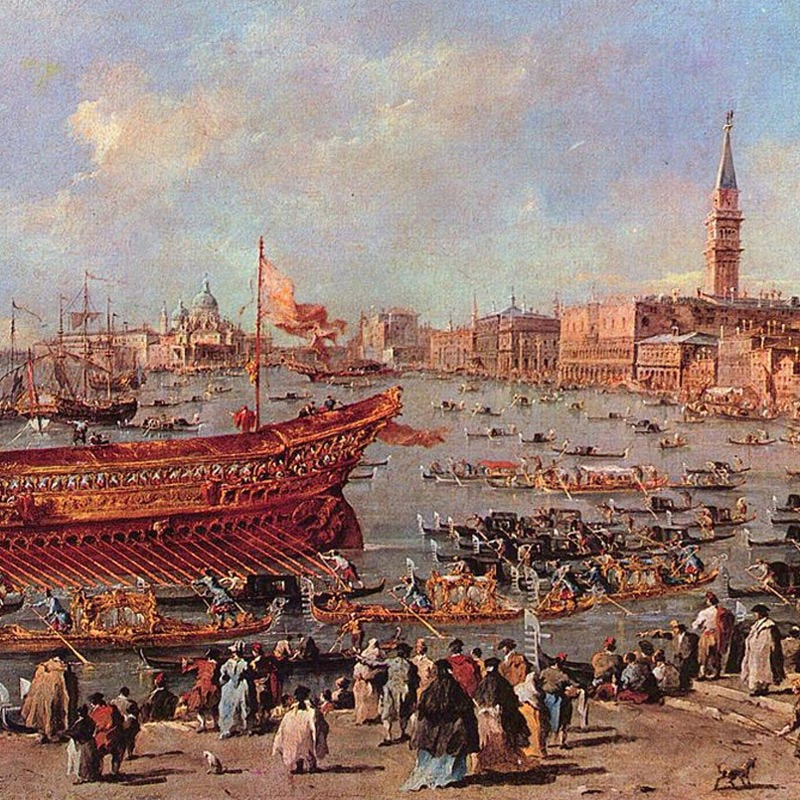
Market wagering is as old as commerce itself. Five hundred years ago, Venetian merchants were betting on papal succession. Fast-forward to 1988, and the Iowa Electronic Markets showed that crowds predicting elections could beat pollsters and pundits. Fast-forward once more to the onchain era of 2015 when Augur emerged, letting anyone mint and trade markets on Ethereum. Decentralised logic settled markets free from censorship and single points of failure; however, they came with high gas costs, clunky experiences, and low liquidity.
Today, Polymarket and Kalshi lead the prediction market arena. Both their odds show up in The New York Times and Financial Times… To be honest, everywhere. Kalshi has had luck with legal battles with the CFTC. Both battle for dominance, but their competition reveals a deeper constraint: current infrastructure hasn’t yet supported the sophisticated betting products that drive billions in traditional markets. Accumulators, conditional chains, and cross-market combinations remain out of reach. Onchain prediction market may face architectural limits that weren’t designed for complex prediction market types.
Current Landscape of Prediction Markets
The prediction market ecosystem today spans three broad categories, each defined by how and where its markets operate.
Polymarket stands out as a flagship onchain platform built on Polygon, leveraging Layer 2 scalability to deliver cost-effective, decentralised markets. Its hybrid use of automated market makers supplemented by off-chain order books has unlocked remarkable volumes, especially in high-profile political events. Yet, like most blockchain-native platforms, Polymarket’s offerings remain largely confined to binary or simple market structures.
In contrast, Kalshi represents a new wave of regulated legitimacy, operating as a centralised U.S. exchange under CFTC oversight. Its traditional limit order book model offers robust price discovery and enhanced market depth, catering especially to institutional participants. However, its centralised infrastructure and regulatory constraints mean that Kalshi struggles to flexibly serve a wide diversity of market types or innovate rapidly.
Meanwhile, protocols like UBET are attempting to bridge on-chain innovation and complex betting primitives, pioneering automated market makers capable of supporting conditional tokens and layered bets on-chain. Yet these remain nascent, relatively low-liquidity players constrained by the fundamental limits of today’s smart contract models.
From this vantage, the landscape divides into:
Centralised platforms(offchain) (e.g., Kalshi) embrace traditional architecture capable of flexible, complex bets, but at the cost of decentralisation.
Decentralised platforms (onchain) (e.g., Polymarket, Augur) are pioneering trustless marketplaces but are constrained to binary or elementary structures.
Hybrid innovators (e.g., UBET) are pushing the boundaries within existing blockchain limits but not yet breaking free.
While these governance models differ, all major prediction market platforms rely on one fundamental technical layer.
What ties these categories together is their foundational reliance on one of two architecture models: Central Limit Order Books (CLOBs) and Automated Market Makers (AMMs)
CLOB VS AMM
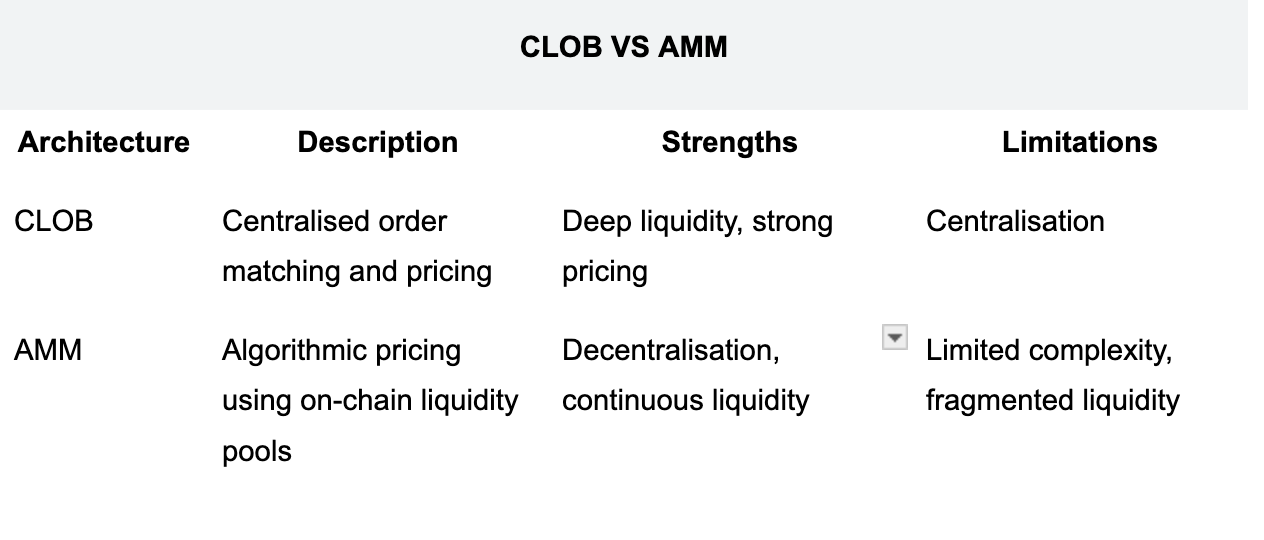
CLOBs deliver depth but limit innovation and openness. AMMs democratise access but stifle sophisticated market designs due to technical and economic bottlenecks.
As the prediction market’s evolution accelerates, so does the need for an infrastructure that transcends these compromises. One that enables rich, scalable, and interactive betting ecosystems suited to both ordinary users and sophisticated traders.
The Constraint Problem
How Blockchain Prediction Markets Work
At their core, prediction markets operate on a simple flow: users place bets by staking assets, smart contracts hold these funds, oracles resolve the event outcomes, and winners receive payouts automatically. However, the simplicity of this process masks complex challenges beneath the surface, challenges will likely intensify as markets grow more sophisticated.
Current Bet Types:
Binary Bets: The predominant form onchain, where users bet on yes/no outcomes (e.g., “Will Candidate X win?”). These markets mint “YES” and “NO” tokens, trading between 0 and 1, reflecting market consensus probabilities via Automated Market Makers (AMMs).
Multi-Outcome Bets: Markets with several possible outcomes (e.g., multiple candidates in an election or various teams in a tournament). Although technically feasible onchain, managing multiple potential resolutions significantly increases contract complexity and gas costs.
Spread and Index Bets: Rather than simple yes/no outcomes, these allow wagers on continuous variables or ranges (e.g., points spread in a game, stock index levels). They require high-frequency data feeds and dynamic odds recalculations, which strain current blockchain infrastructure.
How Prediction Markets Operate Across Blockchain Architectures
Prediction markets onchain today are built on different infrastructures that shape the user experience, scalability, and market complexity.
Ethereum operates like a single-lane conveyor belt. Transactions line up in a global mempool and are processed strictly sequentially, bound by Proof-of-Stake consensus. This design, while secure and decentralised, creates inherent bottlenecks, especially under load.
Solana functions more like a high-speed production line, achieving substantial parallelism via its Proof-of-History consensus. Still, its shared token accounts and dependencies in complex DApps introduce operational challenges, particularly as applications scale.
Polygon, as a Layer 2 solution linked to Ethereum, offers lower fees and faster finality ,but inherits Ethereum’s sequential, shared-state architecture. Under peak demand, this causes similar congestion and latency issues.
Gear Protocol’s actor-based blockchain architecture offers a path beyond these architectural limitations, providing the technical foundation necessary for implementing the complex prediction market products that drive significant volume in traditional markets To clarify, Gear Protocol’s architecture exists in two primary implementations: Vara Network, where these features are live today, and Gear.exe, an Ethereum-facing version currently in development that will bring similar capabilities to the Ethereum ecosystem.
In practice, leading prediction markets mitigate some of these bottlenecks with offchain solutions. Polymarket leverages Polygon’s cost advantage to run an off-chain AMM with batched on-chain settlement, avoiding sequentiality entirely. Kalshi, as a centralised exchange, has no blockchain ordering constraints. These architectural choices highlight that the problem isn’t merely technical; it’s about how markets are designed around blockchains’ limitations
Understanding how transactions flow through different blockchain architectures reveals why certain platforms excel at simple bets while others struggle with complex market structures:
Ethereum:Sequential Ordering & High Costs
User submits transaction → Transaction enters global mempool and waits for validator inclusion → Smart contract executes sequentially, updating market state and user balances → Contract emits events for off-chain systems → Oracle listens to events and resolves outcomes → New transaction submitted with settlement → Payouts processed sequentially in a separate transaction.
Constraint: Each step blocks the next. During high volume, mempool congestion drives gas prices up exponentially, making complex multi-step bets prohibitively expensive.
Solana:Parallel Potential But Shared State Serialisation
User creates a transaction with multiple instructions (e.g., deposit, place bet, claim payout) → Instructions are sent to the leader validator → Program executes instructions, but shared market state forces sequential processing of bets → Oracle subscribes to program state changes and resolves events → Program processes payouts in subsequent transactions.
Constraint: While Solana’s architecture supports parallelism, prediction market programs share market state across all users, forcing serialisation despite Solana’s parallel capabilities. Speed (sub-second finality) helps, but the ordering problem persists. Complex conditional bets are difficult because they require multiple sequential program invocations, and high-volume periods lead to validator overload rather than scalable throughput.
Polygon/Polymarket:Escaping Sequentiality Through Off-Chain Design
While Polygon inherits Ethereum’s sequential smart contract execution, leading prediction markets like Polymarket solve this not by changing Polygon, but by moving market operations off-chain.
User places bet on Polymarket UI (off-chain) → Bet routed to Polymarket’s off-chain AMM which maintains market prices without hitting blockchain → Polymarket operators match orders and accumulate them in batches → UMA Optimistic Oracle fetches resolution data from external sources and resolves outcomes off-chain → Conditional tokens converted by NegRisk CTF Adapter based on Gnosis Conditional Token Framework → Batch of settlement transactions submitted to Polygon Layer 2 → Payouts distributed in a single batched transaction.
Key Insight: Sequentiality remains a Polygon constraint, but it no longer bottlenecks Polymarket because trading never hits the blockchain. Instead, the Gnosis Conditional Token Framework (CTF) with UMA adapters handles complex market logic entirely off-chain. This reveals an important architectural truth: the problem isn’t technical, it’s design-dependent. Polymarket chose centralised custody + off-chain matching to achieve $3.7B in monthly volume on Polygon. The architecture elegantly sidesteps sequentiality by batching, but it requires trust in Polymarket operators and introduces oracle-dependence through UMA’s optimistic resolution model.
Gear: Asynchronous Parallel Processing Without Blocking
User sends bet to Bet Actor → Bet Actor processes transaction asynchronously with private state (updates internal balance) → Market Actor updates outcomes in parallel without waiting for other transactions → Payout Actors execute simultaneously and independently → Results propagate without sequential ordering delays.
Advantage: True on-chain parallelism. A user’s payout can execute while another user’s bet is being placed—neither blocks the other. No global ordering constraint, no mempool congestion, no need for off-chain workarounds. Complex market structures (accumulators, cross-market conditional bets, evolving markets) execute natively without fragmentation across adapters or layers.
The Transaction Flow Problem
To understand why complex betting structures are so challenging, let’s examine how different blockchain architectures handle transactions:
Ethereum Transaction Flow (Sequential Bottleneck):
User submits transaction → enters global mempool → validators process sequentially in blocks → smart contract executes and updates global state → finality reached after 1-15 minutes. For complex accumulators requiring multiple transactions, this means escalating gas costs during network congestion.
Solana Transaction Flow (Fast But Constrained):
User signs transaction with multiple instructions → sent to leader validator → parallel processing where possible, but shared market state forces sequential execution → sub-second finality. Solana’s speed helps, but complex conditional logic still executes within program constraints. Prediction markets that share market state across users can’t exploit Solana’s parallelism.
Polygon Transaction Flow (Cost Optimized, Not Architecture Optimised):
User submits tx on Layer 2 → validator batches → contract updates state sequentially (inheriting Ethereum’s model). Polygon solves cost and speed, but sequential ordering remains. Leading platforms like Polymarket avoid this by moving trading entirely off-chain: users interact with an off-chain AMM, with only final settlement touching Polygon via the Gnosis Conditional Token Framework and UMA oracle adapters. This reveals an architectural truth: the bottleneck isn’t technical impossibility, it’s design-dependent. Polymarket trades decentralisation for scale.
The Core Constraint:
Traditional smart contracts force a sequential execution model: one transaction updates global state, then the next can proceed. This works for simple bets but breaks under complex market structures. Accumulators, cross-market conditionals, and evolving markets require either:
Off-chain workarounds (Polymarket’s approach: centralised matching + batched settlement)
Multiple sequential transactions (expensive and slow on Ethereum)
Program constraints (Solana’s shared state problem)
Gear Protocol offers a third path: asynchronous parallel execution, where multiple market operations happen simultaneously without ordering dependencies. A user’s payout can settle while another user’s bet executes, neither blocks the other.
The Constraint Problem:Conditional Betting Structures
Most onchain prediction markets offer only basic binary bets because traditional smart contracts create fundamental constraints:
Technical Bottlenecks:
Monolithic architecture: All market logic bundled into sequential contracts
Gas cost escalation: Complex multi-step interactions become prohibitively expensive
Throughput limits: Concurrent bets across varied market types strain blockchain capacity
Real-time impossibility: Every state change requires transaction confirmation, preventing continuous updates.
New Types of Bets
The betting structures that generate the most excitement and volume in traditional markets remain largely non-existent onchain:
Accumulators (Parlays): Single bets linking multiple selections where all must win for payout. A four-leg accumulator combining football, tennis, horse racing, and basketball requires managing interdependent outcomes and rolling winnings from each successful leg into the next. The sequential processing and state management complexity make these prohibitively expensive on current platforms.
Conditional Bets: Wagers where subsequent actions depend on prior outcomes. For example: “If Team A wins, then bet the maximum return on Team B’s match.” Platforms like Betwinner offer these features, but they’re centralised systems. Onchain implementation requires complex state management across multiple transactions.
Cross-Market Conditional Bets: Even more sophisticated, bets that combine outcomes from completely different domains. “If Bitcoin hits $50k, then inflation stays below 4%” or “If the Lakers win the championship AND unemployment falls below 5%, trigger payout.” These require coordination between unrelated markets and oracles, something current monolithic smart contract architectures handle poorly.
The global sports betting market generates over $100 billion annually, with parlay betting driving significant growth, hold rates for operators increased from 7.5% in 2021 to 9.4% in 2023 due to accumulator popularity. Yet, onchain prediction markets remain stuck offering primarily binary options.
GEAR’s Solution
What is Gear Protocol?
Gear Protocol’s architecture replaces the traditional monolithic smart contracts with a network of independent “actors” like microservices that operate in parallel with their own private memory and message queues.
Unlike Ethereum’s and Polygon’s sequential transaction processing or Solana’s shared-state model, Gear’s actor system enables:
True Parallelism: Multiple actors process transactions simultaneously without waiting for global state updates
Persistent Memory: Actors maintain state in memory between executions, eliminating expensive storage reloads
Native Messaging: Actors communicate through built-in message passing, enabling complex workflows without blocking
Fault Isolation: Issues in one actor don’t cascade to affect the entire system
Modular Upgrades: Individual actors can be updated without disrupting other components
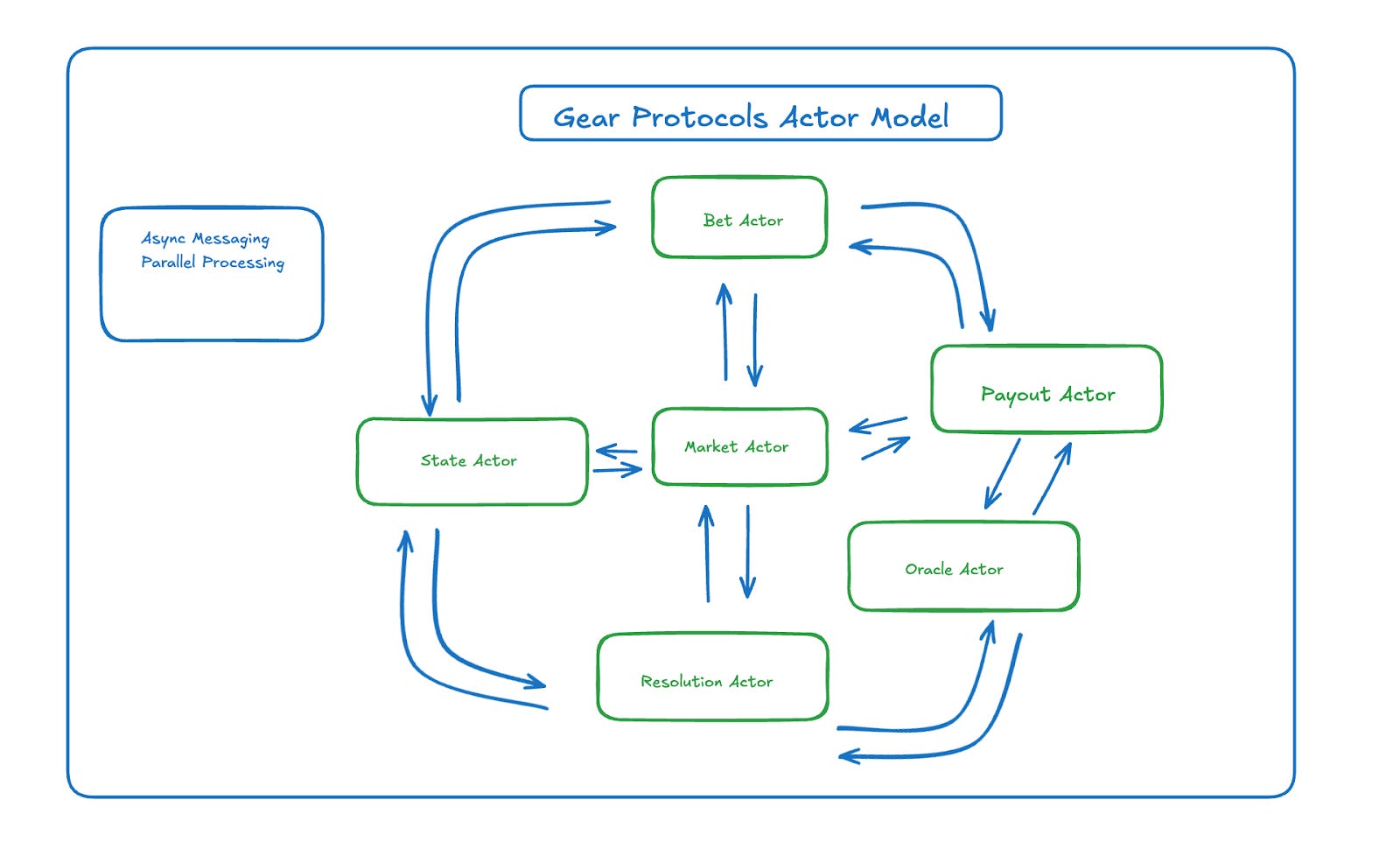
GEAR Protocol’s actor-based architecture can offer additional builder tools to build more complex prediction markets. Prediction markets can break free of global state contention and sequential execution. Persistent in-memory state, native onchain scheduling, and automated market spawning open the door to entirely new categories of markets, real-time sports betting, accumulators, cross-market conditional contracts.
Gear’s actor-based architecture enters, the defining infrastructure poised to reshape the future of prediction markets.
How Gear’s Actor Model Transforms Prediction Markets
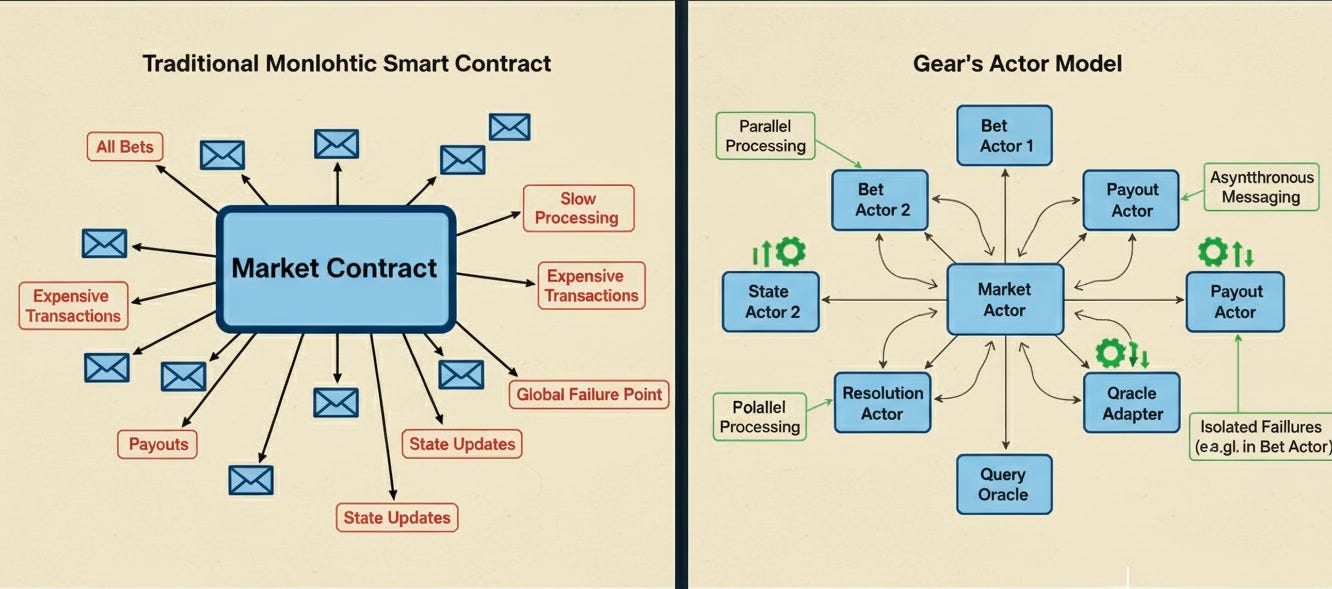
Visual diagram showing monolithic vs actor-based processing
Gear reimagines smart contracts into a network of independent “app workers” or actors, each with private memory and discrete message queues. Rather than forcing sequential execution of all logic in one smart contract, these actors have a unique role and process transactions asynchronously, unlocking parallelism, modular upgrades, and fault tolerance.
Traditional Monolithic Smart Contracts:
Single contract contains all market logic and state
Sequential transaction processing creates queues and delays
Bugs or failures affect the entire system
Complex workflows require multiple expensive transactions
GEAR’s Distributed Actors:
Markets are broken into independent “agents” handling specific functions
Parallel processing allows simultaneous bet resolution and payouts
Failures are isolated to individual actors without system-wide impact
Modular upgrades are possible without affecting other components
Beyond these core benefits, Gear offers advanced capabilities unique to its ecosystem: native on-chain scheduled messaging and delayed message processing, built-in system actors for oracles and schedulers, and developer-friendly APIs that reduce development complexity. These features enable sophisticated bet structures—such as conditional accumulators and dynamic cross-market wagers—that would be difficult or impossible to implement on traditional smart contract platforms.
The GEAR Actor Model: Parallel Execution
Instead of monolithic smart contracts processing sequential transactions, each component becomes an independent actor:
User sends a message to a specific bet actor (not a global contract)
Actors process asynchronously in parallel with an isolated state
Message passing between actors enables complex workflows without blocking
Independent settlement and state updates per actor
Fault isolation means issues in one actor don’t affect others
GEAR Flow: User sends bet → Bet actor updates private state → Bet actor messages market actor → Offchain oracle actor asynchronously updates with outcomes → Market actor triggers payout actors → Multiple payouts processed in parallel.
For an accumulator example: Football Actor, Tennis Actor, Horse Racing Actor, and Basketball Actor all process independently, sending success/failure messages to an Accumulator Coordinator Actor that manages the overall bet state and triggers payouts.
Comparison of Blockchain Infrastructure
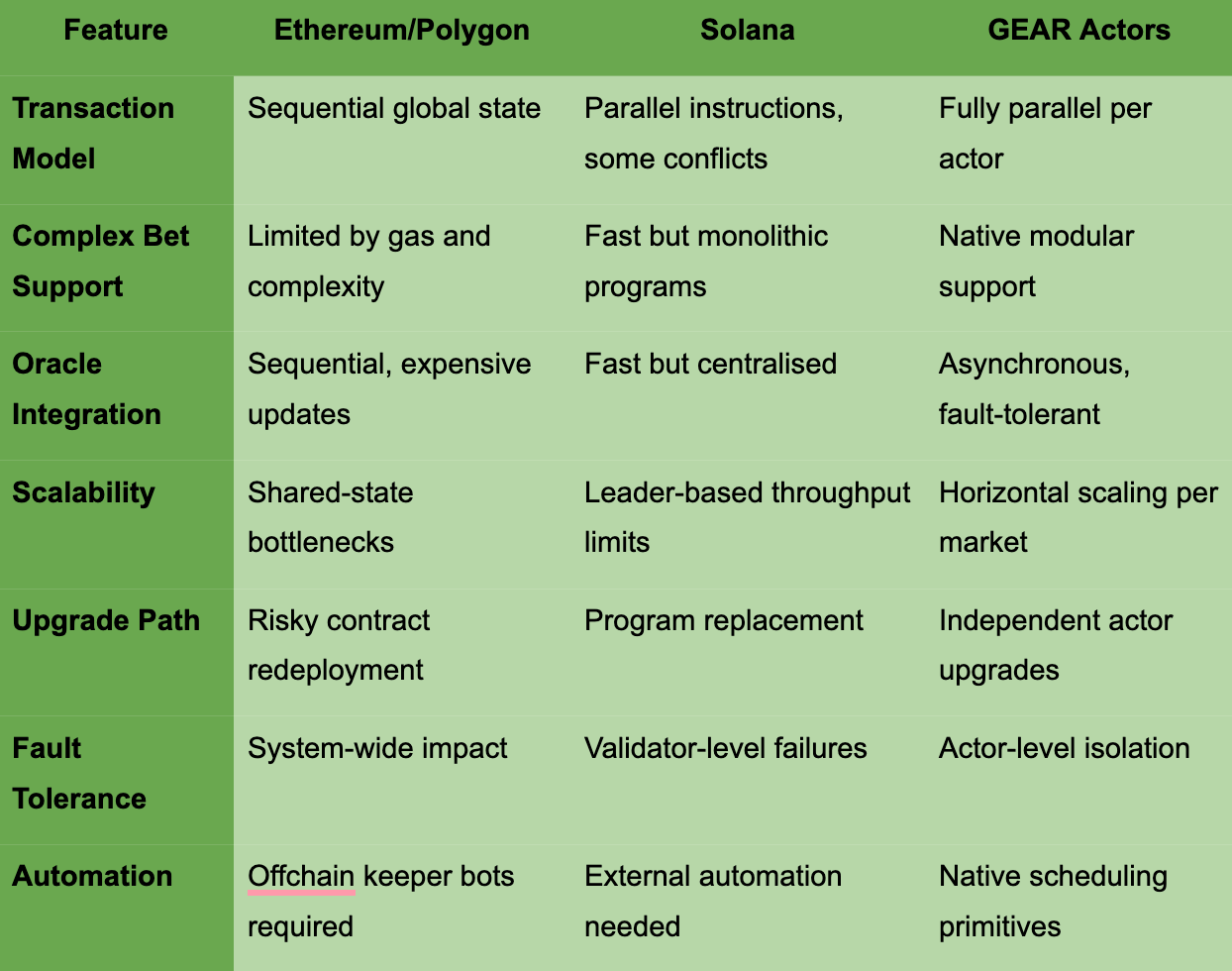
Key advantages:
Breaks the “one contract controls all” bottleneck
Enables parallel processing of multiple bets simultaneously
Supports real-time, fault-tolerant betting experiences
Allows modular upgrades without system-wide risk
Unlocked Capabilities
What New Betting Types Become Possible?
1. Accumulators (Parlays)
GEAR solution:
User Accumulator Bet
├── Football Match Actor (Team A to win)
├── Tennis Match Actor (Player B to win)
├── Horse Race Actor (Horse C to win)
└── Accumulator Coordinator Actor (manages overall state)
GEAR approach:
Football Market Actor handles Team A outcome, sends success message
Tennis Market Actor handles Player B outcome, sends success message
Horse Racing Actor handles Horse C outcome, sends success message
Basketball Actor handles Team D outcome, triggers final payout
Accumulator Coordinator Actor receives messages asynchronously, updates bet state, manages conditional logic
Payout Actor processes winnings independently when all conditions met
All actors operate in parallel. If Tennis Actor experiences delays, Football and Horse Racing continue unaffected. System remains responsive and modular.
2. Cross-Market Conditional Bets
Example: “If Bitcoin hits $50k, then bet inflation stays below 3%”
GEAR implementation:
Bitcoin Price Oracle Actor monitors crypto feeds
Inflation Data Oracle Actor tracks economic indicators
Cross-Market Bet Actor receives messages from both
Settlement Actor triggers a payout only when both conditions are confirmed
Cross-Domain Conditional Market Example: “Bet that Bitcoin closes above $50k AND US inflation falls below 3% this quarter”
Traditional implementation: Complex smart contract managing both price feeds, coordinating oracle updates, handling conditional logic single point of failure with expensive state management.
GEAR implementation: This modular design isolates oracle failures, enables parallel data processing, and supports independent upgrades of each component.
3. Dynamic Tournament Markets
Traditional problem: Single contract managing 63+ March Madness games becomes unwieldy.
GEAR approach:
63 independent Game Actors managing individual matches
Regional Bracket Actors coordinating sections
Championship Actor managing overall progression
System scales horizontally without performance loss
Dynamic Sports Betting: March Madness tournament with 63 games:
Traditional: Massive contract managing all games, bracket logic, and payouts, becomes unwieldy and expensive to update.
GEAR: 63 independent Game Actors, each managing a specific match state, sending results to Bracket Coordinator Actors that update tournament progression. Scales horizontally without performance degradation.
4. Continuous/Evolving Markets
Markets that settle incrementally rather than all at once, enabling:
Live sports betting with real-time odds updates
Political markets updating as vote counts stream in
Financial markets reacting to economic data releases
Real-World Market Examples
Multi-Variable Sports Accumulator
Bet Structure: “Team A wins + Over 2.5 goals + Player X scores + Weather is sunny”
Actor Implementation:
Sports Accumulator Actor
├── Match Result Actor → monitors Team A performance
├── Goals Counter Actor → tracks total goals scored
├── Player Performance Actor → monitors Player X statistics
├── Weather Oracle Actor → provides match day conditions
└── Payout Calculator Actor → processes winnings when all conditions met
Advantages: Each condition processes independently. Weather delays don’t block goal counting. Player substitutions don’t affect team result tracking.
Cross-Domain Conditional Market
Bet Structure: “If S&P 500 rises 3% this week AND unemployment falls below 4% AND Bitcoin stays above $45k, trigger payout”
Traditional approach: Single contract tracking three unrelated data sources, expensive oracle updates, and sequential processing bottlenecks.
GEAR approach: Three specialised oracle actors feeding a conditional bet actor that resolves only when all criteria are met simultaneously.
The Conditional Betting Market Opportunity
Research shows that conditional betting represents a massive underserved market. The global sports betting market is approaching $200 billion by 2030, with parlay and accumulator betting driving growth. Yet onchain prediction markets capture a tiny fraction of this demand due to technical limitations. Constrained by the same architectural limitations affecting all blockchain-based prediction platforms.
GEAR’s actor model architecture offers something new to enable the full spectrum of betting products that drive volume in traditional markets:
Multi-leg accumulators with independent processing per selection
Conditional bet chains where outcomes trigger subsequent wagers
Cross-market combinations linking disparate events and data sources
Real-time dynamic betting with live odds updates
Complex tournament structures with automated bracket management
Implementation & Adoption
Technical Architecture: How It Works
Message-Passing Workflow
User initiates complex bet → sends message to Bet Coordinator Actor
Coordinator deploys specialised actors → creates Market, Oracle, Settlement actors
Actors process independently → parallel execution without blocking
Results flow asynchronously → Oracle actors send updates to relevant markets
Settlement occurs concurrently → payouts process without waiting for other bets
Fault Tolerance Benefits
Oracle delays in tennis don’t block football resolution
Bug in one market doesn’t crash the entire platform
Upgrades happen modularly without service interruption
System gracefully degrades during partial failures
Developer Experience: Building the Future of Prediction Markets
For developers, GEAR’s actor model eliminates the painful tradeoffs that have constrained onchain betting innovation:
Multi-language WASM environment supports familiar tooling
Persistent in-memory state eliminates expensive storage reloads
Built-in messaging primitives enable complex actor coordination
Native scheduling removes dependence on fragile offchain bots
Modular upgrades allow iterative development without migration risk
These capabilities dramatically reduce the complexity of building sophisticated prediction products, opening opportunities for innovation that current platforms simply cannot support.
Adoption Pathway
Developer Migration Strategy
API Compatibility Layer: GEAR markets expose familiar REST/GraphQL interfaces. Existing frontends integrate without complete rewrites.
Gradual Feature Expansion: Start with binary markets matching current functionality, then layer o
n conditional features as developers gain confidence.
Liquidity Bridging: Cross-chain bridges connect existing market positions to GEAR actors, preserving user funds during transition.
Platform Evolution Path
Phase 1: Binary market parity with performance improvements
Phase 2: Simple conditional markets (if-then structures)
Phase 3: Complex accumulators and cross-market combinations
Phase 4: Real-time dynamic markets with continuous settlement
The Path Forward
Prediction markets have proven their forecasting power. Polymarket’s election accuracy and mainstream adoption mark just the beginning. But shared-state blockchain infrastructure has repeatedly limited these platforms at their moment of greatest promise. GEAR Protocol’s actor model represents a fundamental architectural shift, moving from monolithic pipelines to scalable, modular ecosystems.
By enabling true conditional betting, cross-market combinations, and real-time dynamic markets, GEAR aligns exceptional forecasting accuracy with the performance and flexibility required for sophisticated betting products. As prediction markets evolve from niche crypto applications to mainstream forecasting infrastructure, architecture could become key to success.